

WAGO 24V DC DIN Rail Relay Module, SPDT, 16A
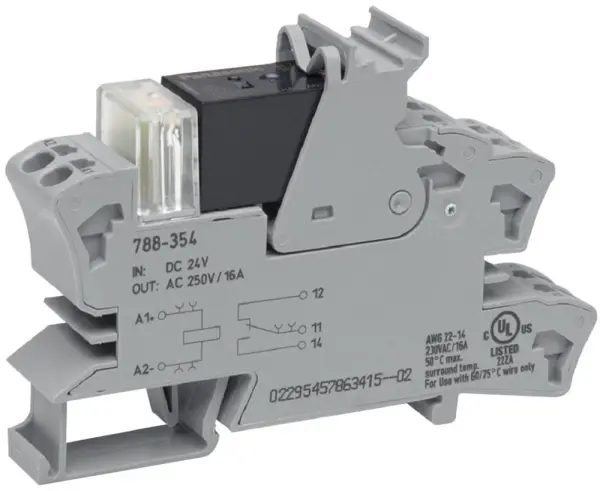
WAGO 24V DC DIN rail relay module with SPDT changeover contact, 16A rating and Push-in Cage CLAMP terminals for 0.34 mm² to 2.5 mm² wires.
The WAGO 24V DC DIN Rail Relay Module, SPDT, 16A is a DIN rail mounted relay with a single SPDT (Single Pole Double Throw) changeover contact rated up to 16A, a 24V DC coil voltage and a maximum contact voltage of 250V AC.
Overview
This relay forms part of the WAGO 788 Series and uses Push-in Cage CLAMP connection technology. Solid or fine-stranded conductors from 0.34 mm² to 2.5 mm² (22 AWG to 14 AWG) can be connected without tools, with a recommended strip length of 9 mm to 10 mm. A red LED provides visual status indication of the relay's energised state.
Key Features
- SPDT changeover contact with a 16A contact rating
- 24V DC coil voltage
- Maximum contact voltage of 250V AC
- Push-in Cage CLAMP terminals for tool-free wiring
- Suitable for solid or fine-stranded conductors from 0.34 mm² to 2.5 mm² (22 AWG to 14 AWG)
- Recommended strip length of 9 mm to 10 mm
- Red LED status indicator
- DIN rail mounting
Dimensions and Weight
Dimensions: width 2.2, depth 0.2 and height 3.3. Weight: 40 g. The compact case supports straightforward installation in standard control panels, cabinets and enclosures, helping to save space within the assembly.
Applications
Suitable for switching motors, solenoids, heaters and lighting, and for use with common low-voltage control systems, PLCs and automation equipment in industrial and commercial environments.

- Contact Configuration: SPDT (Single Pole Double Throw) changeover
- Contact Rating: 16A
- Maximum Contact Voltage: 250V AC
- Coil Voltage: 24V DC
- Connection Type: Push-in Cage CLAMP
- Conductor Size: 0.34 mm² to 2.5 mm² (22 AWG to 14 AWG)
- Recommended Strip Length: 9 mm to 10 mm
- Indicator: Red LED
- Mounting: DIN rail
- Series: WAGO 788 Series
- Width: 2.2
- Depth: 0.2
- Height: 3.3
- Weight: 40 g
- Special Feature: Tool-free wiring
Always follow local regulations and product guidance.
Free standard delivery on UK mainland orders. Express delivery options and international shipping available at checkout.
We offer a 30-day money-back guarantee on most products. For faulty items, contact us within 14 days for a replacement or refund.
View Full Delivery & Returns PolicySecure Transactions
We take the utmost care with your payment and personal details. Our website employs advanced encryption technology, including Secure Sockets Layer (SSL), to protect your information during transmission. You can verify a secure connection by looking for 'https' and a locked padlock in your browser.
Cookie Policy
Cookies enhance your shopping experience by keeping track of your basket and remembering you when you return. We also use banner advertising based on your browsing history to present products of potential interest.
Security Warning
Beware of phishing scams! We will never ask for personal details via email. If such information is required, we'll request you to contact us by phone. If you receive an email requesting sensitive information, do not respond and let us know immediately.
You may like