


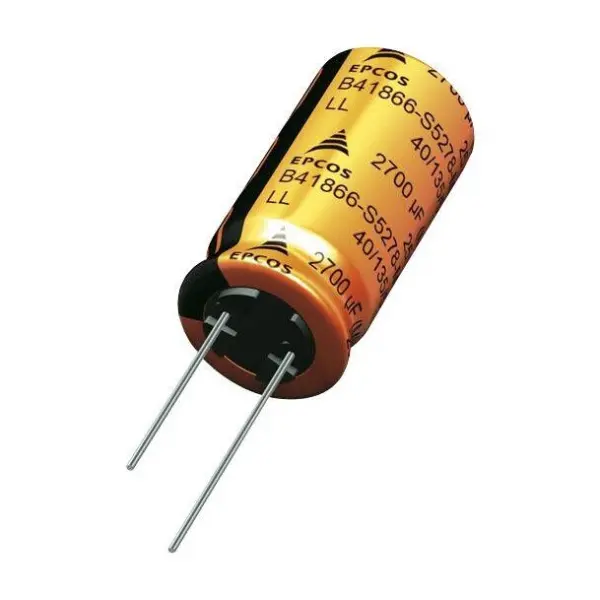
TDK B41888 Series 1000µF 50V Electrolytic Capacitor Radial Leaded
TDK B41888 Series 1000µF 50V radial leaded electrolytic capacitor, ±20% tolerance, rated 10,000 hours at 105°C. Polar through-hole design.
The TDK B41888 Series Electrolytic Capacitor provides 1000 µF capacitance at 50 V DC in a radial leaded, polar through-hole package.
This aluminium electrolytic capacitor is designed for professional and industrial electronic applications. Its polar design and radial leaded format suit through-hole mounting, supporting secure and stable installation. The long-life grade construction provides a useful life of 10,000 hours at 105°C, making it suitable for applications that require sustained operation at elevated temperatures.
Key Features
- Capacitance of 1000 µF with a tolerance of ±20%
- Voltage rating of 50 V DC
- Low impedance at high frequency, supporting performance in high-frequency circuits
- High ripple current capability for demanding current loads
- Charge-discharge proof construction
- Aluminium case with PET insulating sleeve for durability and electrical insulation
- Minus pole marking for clear polarity indication during installation
- Safety vent to provide protection against internal pressure build-up
- AEC-Q200 compliant
- Manufactured to the IEC 60384-4 sectional specification
- IEC climatic category 55/105/56
Specifications
- ESR: 0.039 ohm
- Ripple current rating: 2.54 A
- Width: 3.3, depth: 1.5, height: 4.3
- Weight: 7.711 g
Applications
With an ESR of 0.039 ohm and a ripple current rating of 2.54 A, this capacitor is suited to power conversion and filtering applications. It is intended for use across a wide range of electronic circuits where stable capacitance and robust current handling are required.
Choose the TDK B41888 Series Electrolytic Capacitor for 1000 µF, 50 V DC designs that need a polar, radial leaded component with a rated useful life of 10,000 hours at 105°C.
- For power conversion applications
- For filtering applications
- For professional and industrial electronic circuits
- For through-hole mounted circuit boards
- Series: B41888
- Capacitance: 1000 µF
- Voltage Rating: 50 V DC
- Tolerance: ±20%
- Package: Radial Leaded
- Polarity: Polar
- Mounting Type: Through-Hole
- Useful Life: 10,000 hours at 105°C
- ESR: 0.039 ohm
- Ripple Current Rating: 2.54 A
- Case: Aluminium with PET insulating sleeve
- Special Feature: Low impedance at high frequency
- Special Feature: High ripple current capability
- Special Feature: Charge-discharge proof
- Special Feature: Minus pole marking
- Special Feature: Safety vent
- Compliance: AEC-Q200 compliant
- Standard: IEC 60384-4 sectional specification
- Climatic Category: IEC 55/105/56
- Width: 3.3
- Depth: 1.5
- Height: 4.3
- Weight: 7.711 g
Documents
Always follow local regulations and product guidance.
Free standard delivery on UK mainland orders. Express delivery options and international shipping available at checkout.
We offer a 30-day money-back guarantee on most products. For faulty items, contact us within 14 days for a replacement or refund.
View Full Delivery & Returns PolicySecure Transactions
We take the utmost care with your payment and personal details. Our website employs advanced encryption technology, including Secure Sockets Layer (SSL), to protect your information during transmission. You can verify a secure connection by looking for 'https' and a locked padlock in your browser.
Cookie Policy
Cookies enhance your shopping experience by keeping track of your basket and remembering you when you return. We also use banner advertising based on your browsing history to present products of potential interest.
Security Warning
Beware of phishing scams! We will never ask for personal details via email. If such information is required, we'll request you to contact us by phone. If you receive an email requesting sensitive information, do not respond and let us know immediately.
You may like


