

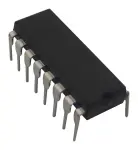
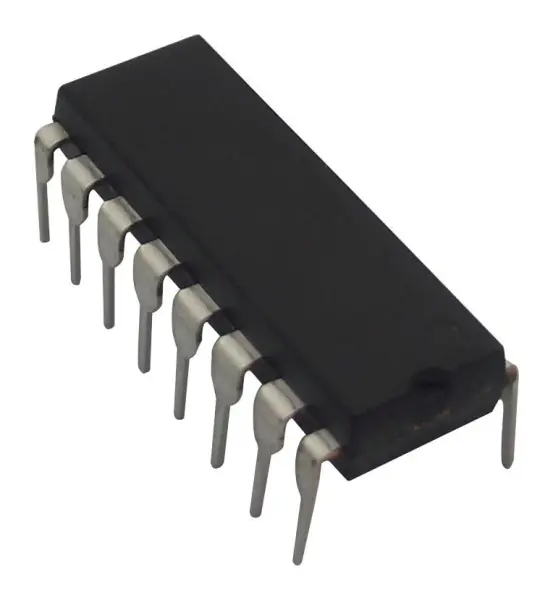
STMicroelectronics ULN2003 NPN Darlington Array 7 Outputs 50V 500mA DIP16
STMicroelectronics ULN2003 seven-output NPN Darlington array, 50V 500mA, DIP16 through-hole. Suited to relays, stepper motors and LED drive.
The STMicroelectronics ULN2003 Darlington Array is a seven-channel NPN driver IC rated at 50V and 500mA, designed to interface low-level logic with high-power loads.
Each of the seven open collector Darlington pairs uses common emitters. The outputs can drive inductive loads such as relays, stepper motors and DC brushed motors, and integrated suppression diodes help protect the device from voltage spikes generated by these loads. The outputs can be paralleled to increase current handling for heavier applications.
Key Features
- Seven open collector Darlington pairs with common emitters
- Integrated suppression diodes for inductive loads
- Outputs can be paralleled for higher current
- Inputs compatible with TTL, CMOS, PMOS and DTL logic levels
- Input pins positioned opposite the output pins to simplify PCB layout
- DC current gain (hFE) of 1000
- Through-hole DIP16 package
Specifications
- Transistor polarity: NPN
- Collector emitter voltage (V(br)ceo): 50V
- DC collector current: 500mA
- Number of outputs: 7
- Operating temperature maximum: 85°C
- Mounting: Through-hole
- Dimensions (width, depth, height): 3.3, 1.5, 4.3
Applications
The device can drive lamps, LEDs, gas discharge displays and relays, and can also be used as a line driver. It suits industrial and electronic control systems where a logic-level input must switch a higher-power load. The DIP16 through-hole format makes it straightforward to prototype and assemble on a PCB.
Specify the STMicroelectronics ULN2003 Darlington Array when a seven-channel, 50V, 500mA NPN Darlington driver in a DIP16 package is required.
- For relays
- For stepper motors
- For DC brushed motors
- For lamps
- Transistor Polarity: NPN
- Collector Emitter Voltage (V(br)ceo): 50V
- DC Collector Current: 500mA
- No. of Outputs: 7
- DC Current Gain (hFE): 1000
- Operating Temperature Max: 85°C
- Mounting: Through-Hole
- Package: DIP16
- Special Feature: Integrated suppression diodes for inductive loads
- Special Feature: Outputs can be paralleled
- Special Feature: TTL, CMOS, PMOS and DTL compatible inputs
- Special Feature: Input pins opposite the output pins
- Weight: 2 gm
- Width: 3.3
- Depth: 1.5
- Height: 4.3
Documents
Always follow local regulations and product guidance.
Free standard delivery on UK mainland orders. Express delivery options and international shipping available at checkout.
We offer a 30-day money-back guarantee on most products. For faulty items, contact us within 14 days for a replacement or refund.
View Full Delivery & Returns PolicySecure Transactions
We take the utmost care with your payment and personal details. Our website employs advanced encryption technology, including Secure Sockets Layer (SSL), to protect your information during transmission. You can verify a secure connection by looking for 'https' and a locked padlock in your browser.
Cookie Policy
Cookies enhance your shopping experience by keeping track of your basket and remembering you when you return. We also use banner advertising based on your browsing history to present products of potential interest.
Security Warning
Beware of phishing scams! We will never ask for personal details via email. If such information is required, we'll request you to contact us by phone. If you receive an email requesting sensitive information, do not respond and let us know immediately.
You may like