


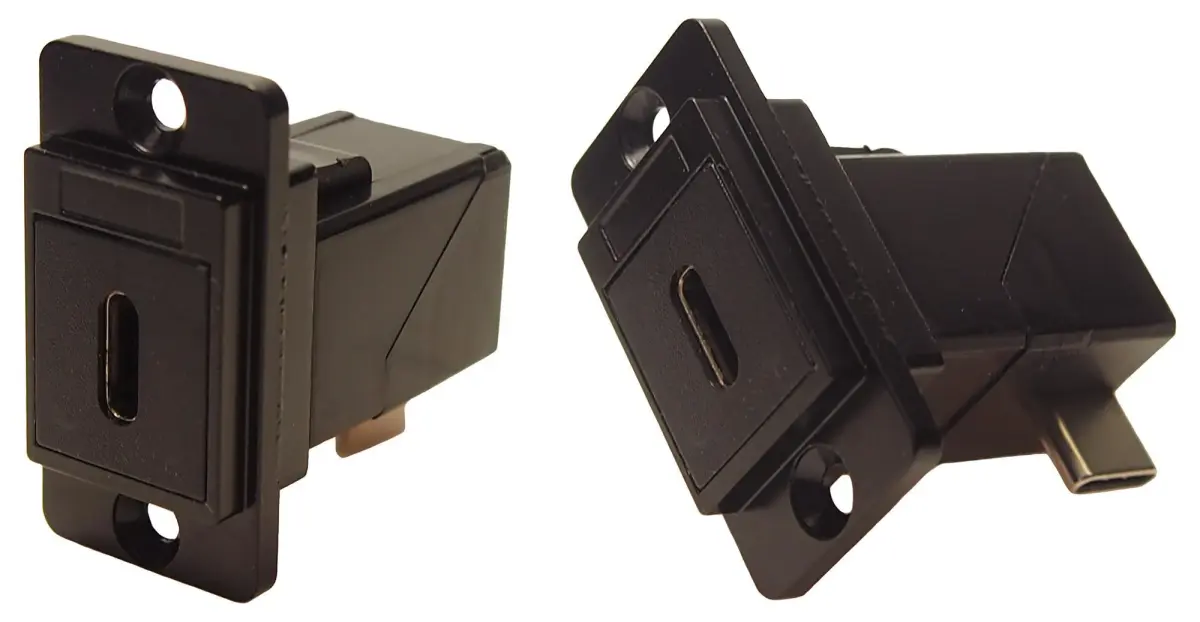
Cliff Dual Slim USB-C Socket to USB-C Right Angle Plug Feedthrough Connector
Cliff dual slim USB-C feedthrough connector rated 3 A per port, with right-angle rear cable entry and 2 mm rear profile for panels.
The Cliff Electronic Dual Slim USB-C Feedthrough Connector is a compact panel connector with a maximum current of 3 A per port.
It provides a USB-C socket on the panel front that connects directly to a USB-C plug on the inside, allowing USB-C charging and data transfer to be integrated into panels and enclosures. The sleek black metal frame includes CSK holes for secure mounting, and the ultra-low rear profile of 2 mm suits applications with tight space behind the panel. The design supports both front and rear mounting for flexible installation.
Key Features
- Fully compatible with USB Power Delivery (PD) 3.1 specifications, supporting fast charging for compatible devices such as modern laptops, tablets and smartphones.
- Maximum current of 3 A per port for reliable power delivery in demanding applications.
- Right-angle (90°) rear cable entry helps route cables neatly and reduces strain, supporting a clean internal layout.
- No soldering or complex punch termination required; a standard cable is used for each port style, allowing quick, tool-free integration.
- Compact external dimensions of 33 mm height and 22 mm width, occupying minimal panel space while providing dual-port functionality.
Applications
The connector is suited to instrument panels, custom computer cases, kiosks and other panel and enclosure projects. It is well suited to product designers, engineers and hobbyists adding USB-C connectivity to custom equipment.
Specifications
- Dimensions: 33 mm height, 22 mm width, 2 mm depth
- Weight: 20 g
- Rear Profile: 2 mm
Choose the Cliff Electronic Dual Slim USB-C Feedthrough Connector when you need a space-efficient way to bring USB-C ports through a panel or enclosure while keeping internal cabling neat and organised.
- For instrument panels
- For custom computer cases
- For kiosks
- For panels and enclosures with tight space behind the panel
- Material: Metal
- Colour: Black
- Mounting: Front or rear, with CSK holes
- Special Feature: Right-angle (90°) rear cable entry
- Special Feature: No soldering required
- Power Delivery: USB PD 3.1 compatible
- Maximum Current: 3 A per port
- Ports: Dual USB-C (socket and plug)
- Height: 33 mm
- Width: 22 mm
- Depth: 2 mm (rear profile)
- Weight: 20 g
Always follow local regulations and product guidance.
Free standard delivery on UK mainland orders. Express delivery options and international shipping available at checkout.
We offer a 30-day money-back guarantee on most products. For faulty items, contact us within 14 days for a replacement or refund.
View Full Delivery & Returns PolicySecure Transactions
We take the utmost care with your payment and personal details. Our website employs advanced encryption technology, including Secure Sockets Layer (SSL), to protect your information during transmission. You can verify a secure connection by looking for 'https' and a locked padlock in your browser.
Cookie Policy
Cookies enhance your shopping experience by keeping track of your basket and remembering you when you return. We also use banner advertising based on your browsing history to present products of potential interest.
Security Warning
Beware of phishing scams! We will never ask for personal details via email. If such information is required, we'll request you to contact us by phone. If you receive an email requesting sensitive information, do not respond and let us know immediately.
Recommended Products


Similar Products


You may like


